
This post may contain affiliate links, which means I may earn a small commission if you make a purchase or sign up through any of the links on this website, at no extra cost to you. View disclaimer for more information.

The first time someone told me about the banana pancake trail, I thought they were joking. They were not. It’s a real thing, it has a real name, and there’s a good chance it’s the reason you ended up searching this.
I’ve done this trail more than once. I’ve also spent years living in Chiang Mai, watching people travel through Southeast Asia the same way I did the first time — arriving in Bangkok with a full itinerary and a bag that’s too heavy, and leaving three months later with half the stuff and twice the opinions. I can tell you what the banana pancake trail actually is, which stops are worth it, which ones are overhyped, and whether the whole thing is as cliche as people who’ve done it tend to claim.
Short answer: it’s popular because it’s good. The longer answer is below.
The banana pancake trail is the well-worn backpacker route through Southeast Asia. The name comes from the fact that guesthouses across Thailand, Laos, Vietnam, and Cambodia started putting banana pancakes on their menus to cater to Western travelers — and the item spread so consistently across the region that the trail itself took on the name.
It’s not a formal route or an official thing. It’s just the sequence of cities and islands that most budget backpackers move through, the guesthouses and hostels that cater specifically to that crowd, and the general culture that forms when you have thousands of twenty-somethings with backpacks all moving in the same direction. Every stop on the trail has a “traveler street” or a neighborhood where the restaurants serve pad thai, falafel, banana shakes, and yes, banana pancakes. The menus look remarkably similar everywhere you go.
The trail is sometimes said with a bit of an eye roll by travelers who want to feel like they’ve gone somewhere more original. But the stops exist for a reason. The infrastructure is good. The transport links are easy. The accommodation is cheap and plentiful. And the places themselves — Angkor Wat, Ha Long Bay, the temples of Chiang Mai, the night markets of Luang Prabang — are genuinely worth seeing.
The Classic Banana Pancake Trail Stops:
Most people do the trail over two to three months, moving roughly north to south or south to north depending on where they fly in. Bangkok is the most common entry point. Bali or Singapore are common exits. For the full breakdown of how to structure the time and what to budget, I’ve written a complete 3-month Southeast Asia travel route that goes deeper on the itinerary side of things.
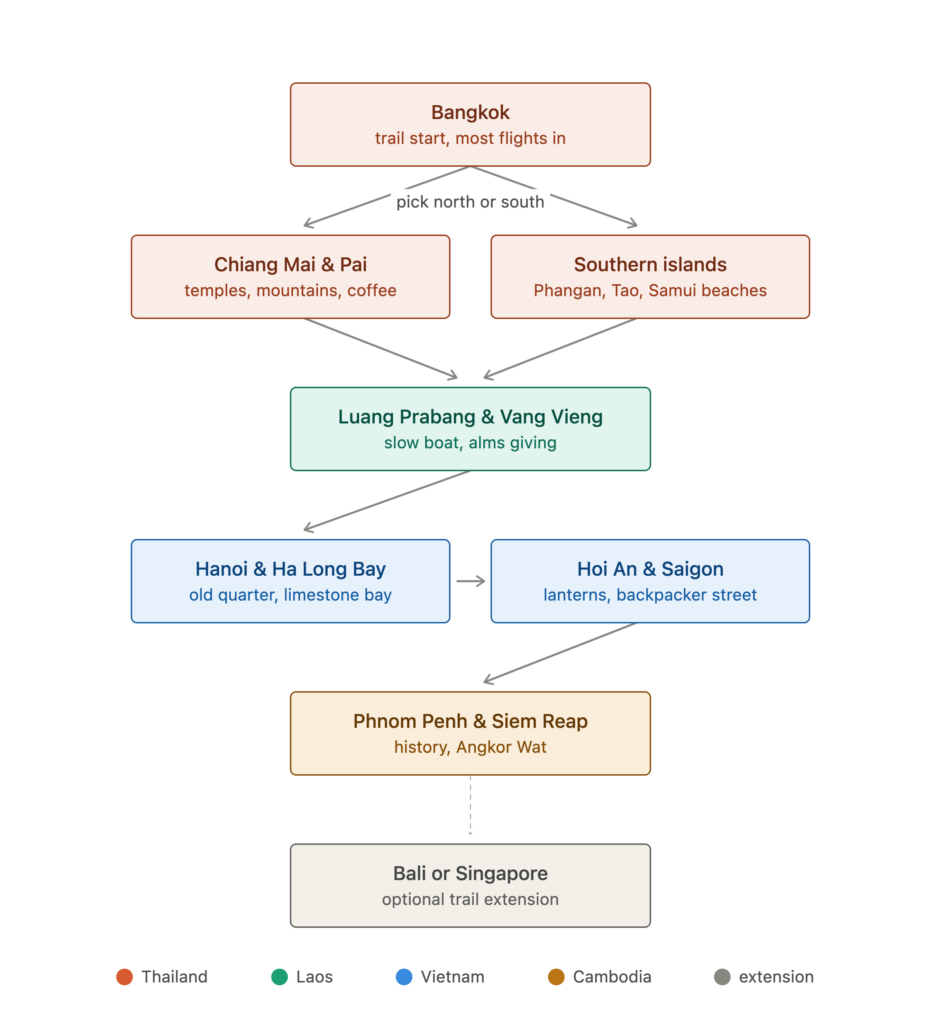
If you’re looking at a map of Southeast Asia trying to figure out how this all actually connects, here’s the shape of it. Picture a rough loop, not a straight line.
Most people fly into Bangkok, since it’s the cheapest and most connected entry point in the region. From there the trail splits north or south inside Thailand before picking back up as one route again.
Going north takes you up to Chiang Mai and Pai, then across the border into Laos, usually via Chiang Rai or a direct flight. Going south instead sends you down to the Gulf islands, Koh Phangan, Koh Tao, Koh Samui, before flying onward rather than backtracking through Bangkok.
From Thailand, the trail moves into Laos: Luang Prabang and Vang Vieng, often connected by the slow boat down the Mekong if you’re coming from the northern Thai border. From Laos, most routes head into Vietnam, entering in the north at Hanoi and working south through Ha Long Bay, Hoi An, and down to Ho Chi Minh City, or the reverse if you’re flying in from the south.
From southern Vietnam, a short flight or overland border crossing gets you into Cambodia: Phnom Penh first, then Siem Reap for Angkor Wat. From Siem Reap, most people either loop back up through Thailand to fly home, or continue on to Bali or Singapore as an exit point.
That’s the actual shape of the map: Thailand at the top and bottom of the loop, Laos and Vietnam and Cambodia forming the middle stretch, with Bali or Singapore as the common “and then I kept traveling” extension. You don’t have to follow it exactly, plenty of people skip a country or go in reverse, but this is the connective logic behind why the trail looks the way it does on a map instead of a random scatter of cities.
If you want the full month-by-month version of this same route with a complete budget breakdown, that lives in the 3-month Southeast Asia travel route post.

Almost every banana pancake trail route starts here. Bangkok is one of the best cities in Southeast Asia for a first landing: the food is incredible, the transport is easier than it looks, and there’s enough to do that a week disappears fast. The Grand Palace, Wat Pho, Chatuchak Market, and the Chao Phraya river ferries are all genuinely worth your time. Khao San Road is exactly what you expect — loud, neon, full of tourists — but it’s part of the experience and worth seeing once.
Give Bangkok five to seven days minimum. Less than that and you’ll rush. More than ten and the novelty starts to wear off faster than the heat.
This is where I live, which means I’m biased, but I’d also argue it’s the most consistently underrated stop on the trail. Chiang Mai is walkable, it has incredible food, and it’s surrounded by mountains, temples, and day trips that can fill weeks if you let them. The coffee shop culture is real. The elephant sanctuaries (the ethical ones) are genuinely moving. Pai, about three hours north by winding mountain road, is small and a little hippie-ish but worth a few days if the timing works.
The north suits you if you’re drawn to cultural depth over beach time. Pack for cooler nights between November and February.
If you go south instead of north from Bangkok, you’re heading for one of the most iconic stretches of the trail. Koh Phangan is the full moon party island — it earns its reputation. Koh Tao is the scuba diving hub; you can get your Open Water certification here cheaper than almost anywhere in the world. Koh Samui is the more polished, resort-oriented sibling of the two.
And then there’s Ko Lipe, which most travelers skip because it takes more effort to get to. It’s my personal favorite island in all of Thailand. The water is absurdly clear, the vibe is calm, and it feels nothing like the islands further north. You take a ferry from Pak Bara — about two hours south of Hat Yai — and it’s worth every bit of the logistics. If you’re deciding between the standard southern Thailand circuit and doing Ko Lipe instead, take Ko Lipe.
Pro tip: You don’t need to do north AND south Thailand on one trip. Pick one and do it properly. A week in Chiang Mai or a week island-hopping in the south — both are better than rushing through both. The full itinerary post has more on how to make this call.

Laos is the stop where the trail splits cleanly into two versions of itself. Vang Vieng is the party. River tubing, open-air bars, neon-lit nights, and mornings that require sunglasses and silence. It’s genuinely fun if that’s what you’re after. It’s also genuinely exhausting if you’re not.
Luang Prabang is the opposite. It’s a UNESCO-listed town on the Mekong River with an informal curfew that keeps things quiet by 10 or 11pm. The morning almsgiving procession — monks walking silently through the streets at dawn to collect offerings — is one of the most beautiful things you’ll see in Southeast Asia. This is the stop where you slow down, rent a bicycle, and sit at a restaurant by the river longer than you meant to.
Do both if you have the time. If you have to choose, Luang Prabang will stay with you longer.
Vietnam is the longest stretch of the trail geographically, and it rewards anyone willing to move through it slowly. Hanoi in the north is loud and chaotic in the best way — the Old Quarter is a maze of motorbikes and street food and colonial-era architecture. Ha Long Bay is a genuine wonder, though the overnight cruise you choose matters a lot; book something mid-range or above to avoid the budget boats that feel more sardine can than scenic.
Hoi An is where most people lose a week they didn’t plan to. It’s pretty in a way that photographs well and also just feels good to be in. The night market, the lanterns on the river, the tailors on every block who’ll make you something in 24 hours. Ho Chi Minh City in the south is relentless in the best way — Bui Vien street is the party corridor where $0.50 beers still exist, and the War Remnants Museum is the kind of place that makes you quiet for a day or two after.
See the Vietnam packing list before you go — there are a few things about the country that catch people off-guard on the first visit.

Cambodia is the stop where the trail gets heavier. Phnom Penh has the Killing Fields and the Tuol Sleng Genocide Museum, and both should be visited even though neither is easy. The city itself has a gritty, alive energy that’s unlike anywhere else on the trail.
Siem Reap is the base for Angkor Wat, and Angkor Wat earns every superlative thrown at it. The temple complex is vast enough that you can spend two or three days moving through it and still feel like you’ve only seen a portion. Get there for sunrise. Rent a bicycle or tuk-tuk for the day. Bring water and more sunscreen than you think you need.
The honest answer is that you can do a version of it in six weeks, but you’ll feel rushed. Two months is the minimum if you want to actually settle into each stop rather than just pass through. Three months is the sweet spot — enough time to slow down in the places that deserve it and still cover the main countries.
Most people enter in Bangkok and exit from Bali or Singapore, depending on where they’re headed next. Some do it in reverse: fly into Ho Chi Minh City or Hanoi and work back toward Bangkok. The direction doesn’t matter much. The time does.
Budget travelers can move through on $30 to $40 a day covering a dorm bed or a cheap private room, street food and local restaurants, local transport, and the occasional entrance fee. Mid-range — private rooms, a few nicer meals, some internal flights instead of overnight buses — runs $50 to $80 a day. The overnight buses and trains are part of the experience and save you accommodation costs on travel nights, so don’t dismiss them entirely.
Vietnam and Cambodia tend to be the cheaper stops. Thailand varies depending on whether you’re in Bangkok or on the islands, where food and accommodation costs jump noticeably. Laos is somewhere in the middle.
Honest note on budget estimates: Costs shift. Prices in tourist areas across Southeast Asia have risen since 2020 and keep rising gradually. The $10 a day rumors from backpacker forums a decade ago are doable, but not as realistic these days. Budget between $30 – $40/day minimum and you’ll be comfortable without stressing.
Here is the honest version:
| Category | Budget range | Notes |
|---|---|---|
| Daily costs (accommodation, food, transport, activities) | $30 to $50/day | Hostels and street food at the lower end; private rooms and sit-down meals at the higher end |
| 90 days total | $2,700 to $4,500 | This is on-the-ground spending only |
| Internal flights | $300 to $600 | Budget airlines like AirAsia, Cebu Pacific; book 3 to 6 weeks out for best prices |
| Visas | $100 to $200 total | Depends on passport; most Western passports get free or e-visa entry to most countries on this route |
| Travel insurance | $100 to $200 | Non-negotiable. SafetyWing for budget; World Nomads if you’re doing diving or motorbikes |
| Gear and packing (one-time) | $200 to $400 | If you’re buying a proper backpack and the right gear before you leave |
| Realistic total | $3,500 to $6,000 | Not including international flights to and from Southeast Asia |
The people who say they did three months on the Banana Pancake Trail for $1,500 were eating street food exclusively, staying in dorm beds every single night, and skipping most paid activities. That’s possible. But it’s not the way most people want to travel for three months, and it’s worth being honest about that before you plan your savings target.

II put together a full Southeast Asia packing list on my Amazon storefront here if you want to see exactly what I’d bring for this route.
The banana pancake trail has its own specific packing logic. You’re moving every few days — Bangkok to Chiang Mai to Laos to Vietnam to Cambodia — mostly on overnight buses and sleeper trains, with island stops and temple runs mixed in. Everything you pack needs to survive being thrown in an overhead rack on a 10-hour bus, survive a Vang Vieng tubing day, and still look vaguely presentable at Angkor Wat the following week. Specific country gear breakdowns are in the Thailand packing list, the Vietnam packing list, and the Philippines packing list. But for the trail as a whole, here is what earns its place across every country on the route.
Please do not do this route without travel insurance! A motorbike accident in Chiang Mai, a stomach emergency in rural Laos, or a hospital visit in Cambodia can cost thousands without coverage. Medical facilities outside major cities are limited, and evacuation costs are significant. My two favorites are:

Also worth reading: the women’s packing list for backpacking Southeast Asia covers the full clothing and toiletries breakdown for the region, including what to wear at temples, what the weather is actually like by country, and the gear I’ve tested across multiple trips.

There’s a certain category of traveler who’s spent significant energy distinguishing themselves from the banana pancake trail. They went to lesser-known provinces. They avoided Khao San Road on principle. They’re happy to tell you about it.
Here’s the thing: the trail hits the stops it hits because those stops are genuinely worth visiting. Angkor Wat is worth visiting. Ha Long Bay is worth visiting. The night market in Luang Prabang is worth visiting. The fact that other people are also there doesn’t diminish what the places are.
The banana pancake trail is worth doing. The question isn’t whether to do it — it’s how much time you spend entirely inside the tourist infrastructure versus pushing slightly outside of it. Stay one neighborhood over from the backpacker street. Eat where you don’t see a menu in English. Take the local bus once instead of the tourist shuttle. The trail gives you enough of a base that you can make those calls easily once you’re on the ground.
What exactly is the banana pancake trail? It’s the nickname for the well-worn backpacker route through Thailand, Laos, Vietnam, and Cambodia, named after the banana pancakes that showed up on guesthouse menus across the region to cater to Western travelers. It’s not an official route, just the path most budget travelers end up taking because the infrastructure, transport, and accommodation are built around it.
How long does the banana pancake trail take? Six weeks is doable but rushed. Two months lets you actually settle into places. Three months is the sweet spot for covering Thailand, Laos, Vietnam, and Cambodia without feeling like you’re constantly packing a bag.
How much does the banana pancake trail cost? Budget $30 to $50 a day for on-the-ground spending, which puts a realistic 90-day total (flights, visas, insurance, and gear included) at $3,500 to $6,000. See the budget table above for the full breakdown.
Is the banana pancake trail worth doing, or is it too touristy? Worth doing. The stops are popular because they’re genuinely good, Angkor Wat, Luang Prabang, Ha Long Bay, not because backpackers lack imagination. You can still step off the main strip in any given town if you want a quieter version of the same place.
Do you have to do the whole banana pancake trail in one trip? No. Plenty of people do it in pieces over multiple trips, or pick two or three countries instead of all four. The 3-month route post has shorter alternatives if you don’t have three months to give it.
If you’re at the stage where you know you want to do the banana pancake trail and you need the actual planning detail — countries in order, monthly breakdown, budget table, visas, what to pack — the complete 3-month Southeast Asia travel route has everything you need to put together an itinerary that works. Or if you’re looking to shop the absolute essentials for your Asia trip, then you can shop my Amazon storefront here!
The trail has been done by millions of people. That’s not a reason to avoid it. It’s a reason to trust that the infrastructure is there, the stops are worth it, and the only thing left is to book the flight and go.
Check out some of my favorite tools and companies I actually use when I travel.
Need a Bank Account for Life Abroad? Wise is the best option for travelers, study abroad students and expats. I use it as my everyday checking account since it lets me hold and spend in multiple currencies without getting hit with a bad exchange rate every time I cross a border.
Want to Travel for Free & Skip the Foreign Transaction Fees? I put my spending on my Chase Sapphire Preferred card and let the points cover flights and hotels I'd otherwise be paying for out of pocket. I've been able to use the points I earn on this card to pay for flights, hotels and meals all around the world!
Please Don't Forget Travel Insurance! Travel insurance protects you against illness, injury, theft, and cancellations. I never go on a trip without it. My two favorites are:
Need a Flight? I personally love using Google Flights to track prices and compare dates before I commit, the flexible date view alone has saved me a lot of money. Skyscanner is another great search engine to find cheap flights because it searches sites and airlines around the globe, so you know no cheap deal is being left on the table.
Getting Around Southeast Asia? Book your buses, trains, and ferries with 12Go Asia. One search shows you every route and price, so you're not digging through ten different local booking sites.
Need a Place to Stay? Book your hotel with Expedia, where I start looking, especially when I want to bundle flights and stays together. Hotels.com is my backup when I want to compare prices or I'm chasing their rewards program for a free night.
On a Tighter Budget? Hostelworld is where I go for hostels. It has the largest inventory out there, and you can search for dorm beds or private rooms depending on what you're after!
Want a Free Way to Travel? Try TrustedHousesitters! You look after someone's home and pets while they're away, and in exchange you get free accommodation (minus the subscription fee). It's a great option if you're traveling long term and want to cut costs. I personally use this as a host and a sitter, and it's truly great!
Need Inspiration or Just Want to See What's Out There? Go Guides is a solid resource for destination guides, must-see landmarks, local markets, best beaches, and things to do, browsable by place or by theme. It's a good stop whether you already know where you're headed or you're still looking for your next destination.
Check out my full packing gear guide for everything I bring on international trips, or browse my favorite travel finds on Amazon for quick links to it all.
Check out my full resource page for every company I use when I travel. I list them all in one place so you can go from planning to booked without digging through old blog posts!

Hey there, I'm Angelique!
I'm a Filipina-American, Chicago native living abroad and running my online design agency from Chiang Mai, Thailand. Over a decade of traveling in, and yes, I still pinch myself. With family split between the US, UK, and SE Asia, travel has always been part of my story. This blog is where I share the honest side of living and traveling abroad, the places I explore, my best study abroad tips from personal experience, and the little hacks that make this life actually work. Glad you're here, friend!
Studying abroad soon?
everything to sort before you go, in one printable page.


I share what I'm actually doing, where I'm going, and the things I wish I'd known before I booked the flight. No spam, just the good stuff that you'll actually enjoy reading.